
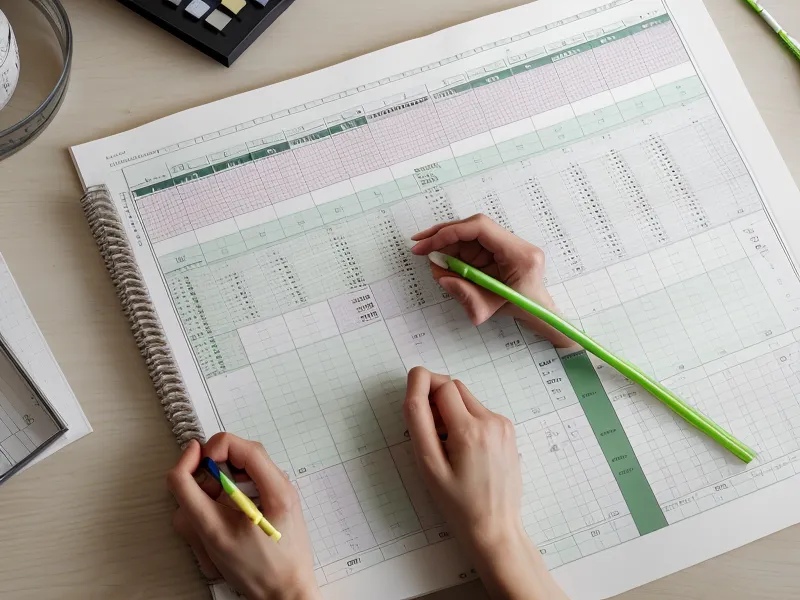
Scrolling past row five of my breakup spreadsheet, the same three words keep showing up: Venus-Saturn square. Row six, same thing. That's not something I can wave off as coincidence anymore, not after two years of data tracking my natal chart against real relationship end dates, and not without admitting that astrology, the thing I filed under "newspaper horoscopes, ignore" for most of my adult life, is apparently doing something a lot more specific than I expected.
Quick housekeeping before the numbers: a few links below are affiliate links, meaning I get a small commission if you buy through them, at no extra cost to you. I only link tools I've actually put my own birth data into, not something I grabbed because the payout looked good. None of this is therapy, either — I've got zero credentials as a counselor, so if a pattern in your relationships feels like more than a scheduling problem, a licensed professional is a better call than a transit chart.
Mapping exes onto a natal chart
Here's the honest version: not the way synastry works, where you compare two full charts using house and sign overlap as the baseline for how two people's life areas interact. That's a different exercise entirely. What I did was narrower. I pulled the birth date, and birth time where I could find it, for each of the seven relationships I've had over the past decade, then checked which planets were transiting my own chart on the date each one actually ended.
I already track Mercury Retrograde separately, mostly to explain workplace communication meltdowns, so folding relationships into the same habit wasn't a huge stretch. Saturn return works on similar logic, and if you want to try the manual version, how to find my Saturn return is the same process I used to line mine up against these transiting squares.
None of this replaced things that already hadn't worked. I'd hired a career coach a while back for an unrelated work problem, and got genuinely solid, generic advice — the kind that applies to almost anyone — but it never touched the specific loop I kept hitting, at work or in relationships. A friend of mine who spends his weekends building custom mechanical keyboards heard about the spreadsheet while we were walking around Sloan's Lake Park, and his exact reaction was something like "so it's just debugging, but for your love life." That's not far off.
The reason I trust the pattern at all actually traces back to work. Flipping through old Q3 project notes one afternoon, I noticed my three best sprints that quarter all landed while Mars was sitting in Capricorn — not proof of anything, but the kind of overlap that's hard to un-notice once you're the type of person who keeps this many spreadsheets.
What the numbers actually showed
Five of the seven relationships ended while transiting Saturn was squared against my natal Venus. That's not a subtle ratio. Venus covers how I connect with people, Saturn covers where structure gets tested, and a square between them is the friction aspect — the one that shows up when what you want and what's actually sustainable don't agree. Look, I know a seven-point dataset doesn't impress anyone with an actual statistics background, and if a colleague brought me those numbers to justify a process change at work, I'd tell them to collect more before presenting it to stakeholders.
Still, it's the same feeling as checking a weather forecast that keeps calling for rain on the one weekend you planned something outdoors — eventually the pattern outweighs your urge to call it bad luck.
What knowing about a bad transit actually changes
Testing this in real time answered that better than the spreadsheet did. Mars sat conjunct my descendant during one stretch where I had a date planned with someone new — in project terms, that's a high-conflict team member joining a sensitive phase of the work. Nothing about the evening went smoothly: a lost reservation, then a flat tire on the drive back. What changed wasn't the transit. What changed was that I'd already seen it coming, so instead of spiraling, we just got tacos and dealt with the tire together. Knowing the weather doesn't stop the rain. It just means you bring an umbrella.
Where the Moon and Soul-Path Stuff Fit In
Venus and Saturn explain the friction, but they don't explain why I keep picking a specific type of partner in the first place. That's more of a Moon question. I also took a Moon Reading at one point, mostly to see if my emotional wiring matched the wreckage on the timeline, and it turned out to focus heavily on the tension between my Moon's need for security and my Venus's pull toward novelty — the fuller version of that is in what your Moon sign actually says about your emotional patterns.
Lunar phases matter for timing too, though I track those separately for career decisions rather than relationships. North Node placement is supposed to point at longer-term purpose instead of relationship patterns specifically, so I've mostly left that thread out of this particular audit.
For the parts of this that don't fit neatly into "Saturn is grumpy, plan accordingly," I've also poked around Soul Manifestation, which leans more into a broader soul-path narrative than the data-heavy approach I usually take. It's not where I'd start, but it's a reasonable bridge between what the data shows and why I keep doing this to myself in the first place.

Checking for confirmation bias
I've read enough skeptic blogs to know the obvious objection. Look for patterns in enough data and you'll eventually find a constellation, whether or not it means anything — that's confirmation bias in its purest form, and I'm not claiming my spreadsheet is immune to it. I initially thought the whole concept of orbs — how many degrees off-exact an aspect can still be and count — was astrologers giving themselves wiggle room to always be right. I still think that's a fair criticism. What keeps me from deleting the tracker anyway is the specificity: it's not just that things went wrong, it's that they went wrong in the shape the transit predicted, repeatedly, across relationships that had nothing else in common.
The One Takeaway Worth Keeping
So what do you actually do with any of this? Here's the rule I'd take from my own audit: before writing off a repeating pattern as bad luck, check whether it clusters around a specific recurring transit instead of spreading evenly across your history. If it clusters, that's information about timing, the same way a forecast is information about timing — not a verdict, just better odds for planning around it. Astrology hasn't made me psychic, and it hasn't rewritten my relationship history. What it's given me is a way to plan around conditions instead of treating every rough stretch as equally random. If you want a low-effort way to start your own version of this, getting a Moon Reading is a reasonable first data point — it at least tells you where to start looking.