
A sun-sign horoscope and an actual natal chart have about as much in common as a one-line executive summary and a full requirements doc. One tells you the packaging, the other tells you what's actually inside. That gap is the whole case for astrology for skeptics: the horoscope version is fortune-cookie filler, but birth chart data, cross-referenced the same way I cross-reference everything else in project management, turned into a pattern I couldn't argue with anymore. I'm still the project manager in Denver who color-codes sprint boards for fun, and somewhere along the way, planetary transits started showing up on that same calendar.
Quick disclosure before we go further: some of the links below are affiliate links, and if you buy through one, I earn a small commission at no extra cost to you. I only link tools I've actually run my own data through — the same transparency standard I'd expect from anyone reporting numbers to a stakeholder.
Before any of this, a friend loaned me a Law of Attraction workbook with vision boards, affirmation scripts, and the whole kit, but it never once matched how I actually make decisions at work. Charts and transits did, which is the only reason I kept going.
Your Sun Sign Is Just the Executive Summary
Most people stop at their Sun sign, which is a little like reading the cover page of a project charter and assuming you understand the full scope. It's directionally true but missing every technical spec that actually matters. My Sun sits in Scorpio, but it's my Virgo Rising that explains the compulsive color-coding: the sock drawer, the spreadsheets, all of it.
The real substance sits in what most birth chart guides call the Big Three: Sun for core identity, Moon for emotional processing, Rising for how you interface with other people. I've already written about how my Moon sign lines up with my own emotional patterns during high-pressure sprints, and the short version is there's a measurable lag between an external stressor and my internal reaction to it that matches my lunar placement almost exactly. The gap between a Sun sign and a Moon sign is its own separate rabbit hole, worth its own read, not this one.
Why Degrees Do More Work Than the Sign Itself
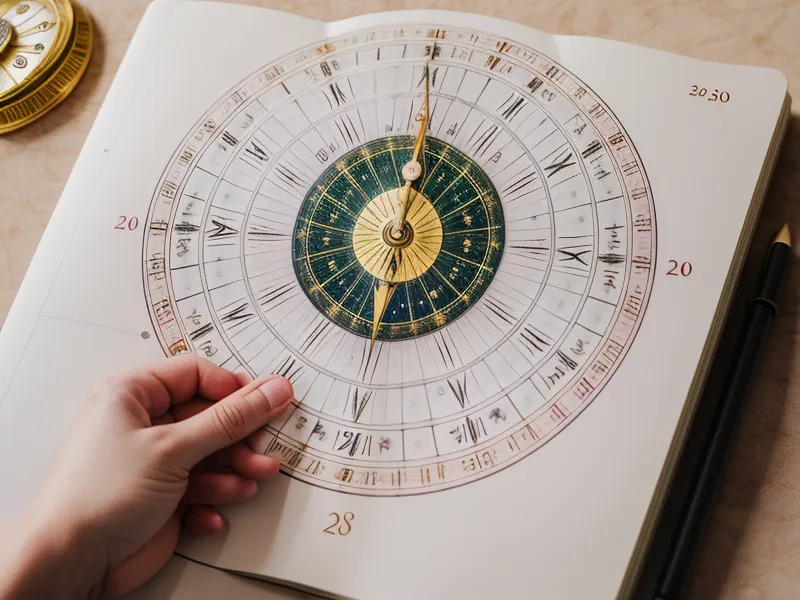
If you want to go past the horoscope version of astrology, degrees are where the real information lives. Each sign covers thirty degrees, and for a long time I assumed a planet simply being "in" a sign was the whole story. It isn't. What matters is the exact angle, the aspect, that a moving planet makes to a planet already sitting in your birth chart.
Five transits went into the tracking at once, logged by degree, sign, and whatever happened at work that day, in the same spreadsheet I use for sprint velocity. A transit sitting at a random degree of a sign did close to nothing. The same transit landing on the exact degree of a planet already in my birth chart was a different story entirely — productivity would spike or completely fall apart, and the spreadsheet made the difference obvious in a way a vague mood check never would. If the math loses you at first, a personalized Moon Reading lays out your placements visually before you have to do any of the degree arithmetic yourself, which is roughly how I got oriented before trusting my own manual calculations.
Planetary Transits Are a Forecast, Not a Verdict
Look, astrology isn't going to tell you which Thursday you win the lottery. It behaves more like a weather forecast or a Gantt chart for a season you haven't lived yet. It shows you the general climate of a stretch of time, not a guaranteed outcome. Certain windows in my chart turned out to be reliably better for deep, heads-down work, and others suited client calls and negotiation better, and the spreadsheet made that split obvious after enough entries piled up.
One winter I noticed a cluster of rough aspects lining up right when a software rollout was scheduled to go live, so I pushed the date back several weeks to a window that looked quieter on paper. That rollout ended up being the smoothest one I've managed in years. Was that the planets or just better sequencing? Honestly, probably both, and I've gone deeper into timing decisions around lunar cycles elsewhere, so I'll leave the moon-phase mechanics out of this piece. I'm not a professional astrologer, a psychic, or anyone certified in anything cosmic — just someone who likes fewer fire drills.
The clearest confirmation came from something almost embarrassingly analog: an old paper journal, not the spreadsheet. Digging through it for notes from a rough stretch a while back, I checked the date against the printed transit calendar taped above my desk, marked up in two different ink colors from a dozen separate check-ins, and transiting Saturn was sitting squared to my natal Sun that exact week. Four weeks of checking that same pairing against other rough stretches in my notes, and it held up often enough that it earns its own line in the spreadsheet now.
Houses: The Departments Doing the Actual Work
Picture your chart as a company org chart: planets are the people, signs are their personality types, and houses are the departments they're assigned to. I assumed the whole house system was nonsense until transits through my 6th house, which governs daily routine and health, started tracking almost too closely against my actual gym attendance. Venus in your 2nd house and Venus in your 10th house are still doing very different jobs regardless: one sits closer to accounting, the other closer to public relations. I've gone deeper on how the houses actually break down in a separate piece, so I'll stick to the practical version here.
Desmond, who sits two desks over in our department and still unpacks that ridiculous labeled lunch cooler he hauled back from some conference every single day, was the one who actually asked to see the math after a rollout landed three weeks early. I told him it was Saturn clearing my 6th house. He went back to his lunch cooler without much of a follow-up question.
Cross-checking those house placements against a Moon Reading came later, after months of an apparently miscalculated cusp finally got caught, which says more about my own manual math than about the method itself.
Where Astrology Meets the Rest of My Focus Toolkit
Charts aren't the only system running on my desk. I've also been testing Billionaire Brain Wave alongside the transit tracking, which works off audio frequencies instead of planetary math entirely. It's a different lever aimed at the same goal of staying in a working flow state longer than coffee alone manages. Pairing a structural read on my own tendencies with a separate tool built for focus isn't a contradiction; it's just two inputs feeding the same spreadsheet-shaped brain.
Astrology as a Tool, Not a Belief System
I don't think the planets force anyone to do anything, and I'd push back hard on anyone who tells you otherwise. What months of entries did convince me of is that a chart works less like fate and more like a personality framework that updates itself in real time, closer to a detailed assessment than a prophecy. A reader named Luisa Herrand emailed me after an earlier post about a 90-day experiment with a Moon Reading that had four numbered points, an actual subject line, and more structure than half of my own sprint retros, laying her own tracking notes next to mine, and the overlap between two strangers' spreadsheets was closer than either of us expected.
There's plenty this piece doesn't cover. I haven't hit my own Saturn return yet, so that particular reckoning stays parked for a future entry. The North Node sat in my chart for months before I understood it points toward long-term direction rather than daily mood, and no, none of this is about blaming Mercury retrograde for a slow week at work. That's an entirely separate tracking project. I'm also not a doctor or a licensed therapist, so if you're dealing with an actual health or mental health issue, a professional beats a chart every time.
None of this requires a spreadsheet to be useful. Start with your own Big Three, track your mood against the calendar for a few weeks, and you'll probably find your worst days aren't as random as they feel. That's the one thing worth taking from birth chart basics even if you never build a single formula. If you want to see how far the rabbit hole goes, my full Moon Reading writeup is the closest thing I've found to an owner's manual for my own brain, spreadsheet and all.