
The detail everyone fixates on with Pluto in the birth chart might be the wrong one entirely. A reader named Luisa Herrand emailed me with her usual numbered list of questions — she always sends a clean subject line and clean bullets, which I appreciate more than I probably let on — and question three stopped me cold: she wanted to know why her Pluto in Scorpio explained her divorce when her sister, who has the exact same placement, never went through anything close to that kind of upheaval. I didn't have a tidy answer waiting in my astrology data spreadsheet. So I went back through my notes, and what I found changes how this whole natal chart placement should be read.
The Sign Isn't the Signature
Here's the misconception: that your Pluto sign is some kind of personal transformation script, written specifically for you. It isn't, and the math makes that obvious pretty fast. Pluto takes roughly 248 years to complete one orbit, which means it sits in a single zodiac sign for over a decade at a stretch — sometimes more than twenty years. Everyone born in that window shares the sign. Luisa and her sister both having Pluto in Scorpio tells you about their generation, not about either of them individually. It's a bit like knowing two people were born the same year a recession hit — it tells you they lived through the same economic backdrop, not what either of them actually did with their career because of it.
Look, when I first pulled Pluto sign data next to my own decisions, I expected nothing, and for the sign alone, I was right — no correlation, no pattern, nothing worth logging in the astrology data spreadsheet. Pluto has carried that reputation for transformation and power since it got formally classified back in 1930, and somewhere along the way, the sign became shorthand for a story that actually belongs somewhere else in the chart.
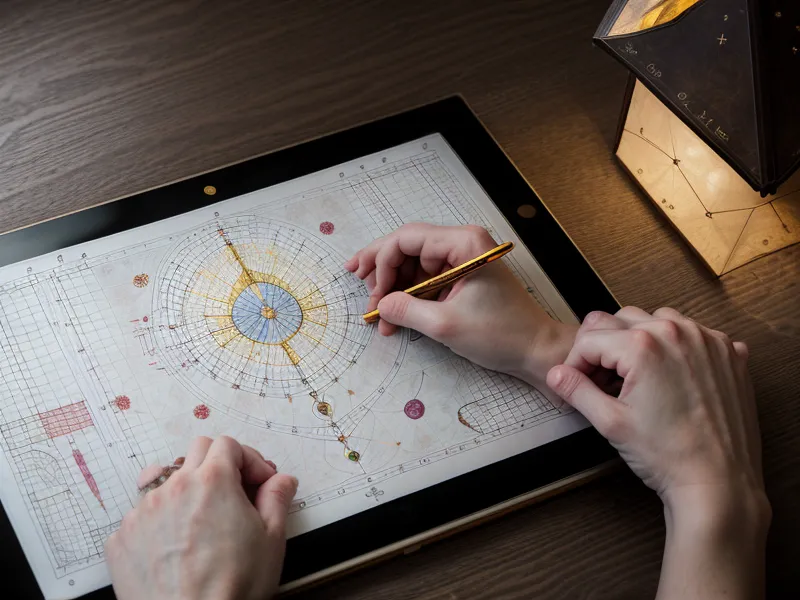
Why the House in Your Natal Chart Carries the Real Story
The personal part is the house, not the sign. A house in a chart is just a section of life — money, home, career, relationships — and it depends entirely on your exact birth time and location, which is why no two people in the same family tend to share one. Pluto sitting in your tenth house tends to rearrange career and public standing. Pluto in the fourth reaches into home and family structure instead. Same planet, same sign as millions of other people, completely different territory depending on where the house lands for you specifically.
Other placements work the same way, just faster or slower depending on what's moving. Your rising sign shapes how people read you in the first ten seconds of meeting you. Your midheaven leans toward career direction. Saturn return marks a specific multi-year pressure test, and your north node points toward unfinished business more than destiny, tangled up with your South Node and the old habits it keeps pulling you back toward. None of those get explained here — that's a rabbit hole for another day — but they all share the same rule Pluto does: the sign is background, the placement in your actual chart is where the personal story sits.
What a Hard Pluto Transit Actually Triggers
The second myth is louder: that a hard Pluto transit causes the external crisis. It doesn't. What it does is turn up the volume on whatever you were already avoiding until ignoring it stops being an option. My screen setup gives this away daily — one monitor running the project trackers I get paid to stare at, the other holding a browser tab with whatever transit chart I'm cross-referencing that week, a calendar taped to the wall above the desk with two colors of pen marking dates that mattered. The pattern isn't subtle once you're logging it: friction shows up first, the so-called crisis follows later, and by then it's just catching up to something that was already true.
Take something smaller and faster than Pluto as the example, because it's easier to check against real weeks. I started noticing that the sharpest work conflicts on my calendar clustered almost exactly whenever Mars was moving through my sixth house — the section tied to daily work and routine, not the big career overhaul zone. That's a much smaller, faster version of the same mechanism Pluto runs on a decades-long scale: the planet doesn't cause the conflict, it just times when the existing tension gets loud enough to notice.
My coworker Desmond thinks the whole habit is a little unhinged, and he's not shy about saying so over lunch, usually somewhere between bites and adjusting the compartmentalized cooler he's hauled to the office ever since some conference a few years back. Fair reaction. I don't have a scientific explanation for why the timing lines up as often as it does, and I'm not going to pretend I do. But "I can't explain the mechanism" and "the pattern isn't there" are two different statements, and only one of them matches what's actually in the data.
How to Check Your Own Placement Without Panicking
Start with the friction, not the forecast. Wherever you're feeling the most resistance right now — a decision you keep avoiding, a routine you can't stand but haven't changed — that's usually close to where Pluto is digging, assuming it's touching an angle in your chart at all. Then check the house it's sitting in, because that tells you the department of life involved far better than the sign does. After that, separate your timelines. A moon reading tracks something that cycles roughly every 29.5 days, which is closer to a weather forecast than a life sentence — useful for reading a mood, useless for predicting a decade. I've laid out how that sun, moon, and rising sign combination fits together elsewhere, and it's worth understanding before you add something as slow as Pluto into the mix, or you'll end up treating a monthly mood swing like a structural collapse.
Mercury retrograde gets blamed for plenty, and I've written separately about tracking Mercury through the houses for workplace communication, but that's a day-to-day tool, not a decade-to-decade one — don't confuse the two timelines or you'll misread which planet is actually responsible for what's happening. I tried a Law of Attraction workbook a while back looking for something that would just tell me what to manifest and when, and it never once matched how I actually make decisions — too vague, no timing mechanism, nothing I could check against an actual date on a calendar. Astrology data, whatever its flaws, at least gives me something falsifiable to argue with.
None of this replaces judgment, and it definitely doesn't replace professional help. If a placement search is turning into something closer to real distress, that's a licensed counselor's job, not a spreadsheet's. Treat all of this the way you'd treat a personality test or a long-range weather forecast: useful for noticing patterns, useless as a verdict on your future.

The Takeaway for Your Own Chart
I was cutting through the Denver Botanic Gardens on a break between meetings when the actual answer to Luisa's email clicked into place — not some grand revelation, just the obvious thing I'd been dancing around: her sister's calm and her own upheaval were never going to show up in the sign, because the sign was never the personal variable. The house was. Once I wrote back with that distinction instead of a Scorpio explanation, her follow-up email — still numbered, still perfectly organized — said it finally made sense why the same placement could play out so differently for two people who share half their chart.
So if you're looking up your own Pluto placement, skip the temptation to explain your whole life through the sign. Check the house. Check what's actually rubbing you the wrong way right now. I still keep a moon reading review on file next to my transit notes, because the fast cycle and the slow one answer different questions, and mixing them up is how you end up blaming a dwarf planet for a bad Tuesday that was really just Mercury doing its thing. Pluto in the birth chart isn't a curse or a destiny — it's a slow, structural pressure test, and the sign was never going to tell you where it's pointed.