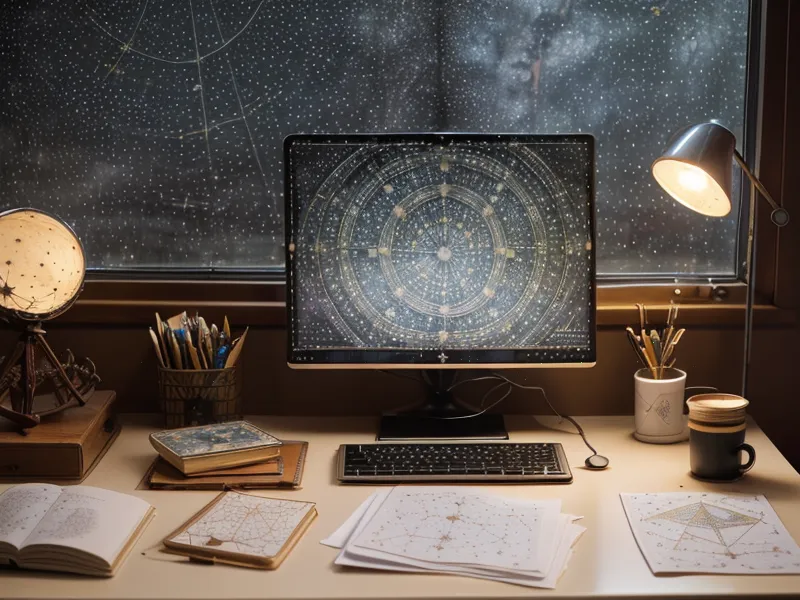
One evening late last November in Denver, I was staring at a messy project schedule and a birth chart app. I realized my burnout wasn't a lack of discipline, but a total misalignment with my 6th house placements that I’d been ignoring for years. The blue glow of my dual monitors reflected off a cold, half-finished cup of coffee while I color-coded my transit spreadsheet, trying to figure out why my productivity felt like it was hitting a brick wall every afternoon despite my 'perfect' habits.
Look, I know how it sounds. I’m a project manager. My life is built on Gantt charts, Jira tickets, and clear deliverables. But after a year of tracking my own data, I’ve had to admit that the 6th house—the part of the chart that deals with daily work, health, and routines—is a surprisingly effective framework for understanding why some days feel like a breeze and others feel like a slog through wet cement. I’m not an astrologer or a psychic, and I have zero medical training; I’m just a guy with a data-tracking habit who noticed patterns that my calendar couldn't explain.
The 6th House: More Than Just a To-Do List
In the standard division of a Western tropical birth chart, there are 12 houses. Each house occupies 30 degrees of the 360-degree circle, and the 6th house is located in the bottom-right quadrant. Traditionally, this is known as a 'cadent' house. While the 1st house is about 'you' and the 10th is about your 'career,' the 6th is about the unglamorous stuff in between: your morning coffee, your gym routine, and how you handle your inbox.
As a project manager, I live by spreadsheets, but I started noticing that my 'productivity' varied wildly based on where planets were moving through this sector of my chart. I used to think that if I just applied enough willpower, I could force myself into any routine. But astrology suggests that we each have a specific 'rhythm' encoded in our 6th house. Fighting that rhythm is like trying to run a marathon in a blizzard—you might finish, but you'll be miserable and exhausted.

Finding the Sign on Your 6th House Cusp
To start using this, you first need to look at which zodiac sign sits on the cusp (the starting line) of your 6th house. For example, if you have Virgo on the 6th house cusp, you might thrive on hyper-organized, detail-oriented routines. If you have Sagittarius there, a rigid schedule might actually make you feel trapped and less productive. I realized that my own placements demanded more flexibility than the 'hustle culture' blogs were recommending.
I started cross-referencing my daily energy levels against the sign on my 6th house cusp, realizing why my 'perfect' 5:00 AM gym routine felt like a death march whenever Mars was in a difficult aspect. Early last spring, I finally stopped fighting my chart and started scheduling high-focus tasks during favorable transits. The moment I made that shift, the friction in my workday started to dissolve.
The Mercury Connection and the 88-Day Cycle
The 6th house is modernly associated with Virgo and its ruler, Mercury. Mercury has an orbital period of approximately 88 days. This means that roughly every three months, Mercury completes a cycle that can reset or shift how you process information and handle your daily tasks. If you've ever felt like your brain 'reboots' every few months, you're not imagining it.
During these cycles, I noticed my 'embarrassing' spreadsheet actually predicted my mid-afternoon slumps better than my Outlook calendar did. When Mercury is transiting your 6th house, it’s often a time of high mental activity, but it can also lead to overthinking. I’ve learned to use these periods for 'deep work' rather than administrative fluff. If you're interested in how other planetary movements affect your work life, you might find my experience with North Node and South Node Career Insights after months of testing relevant to how you view your long-term trajectory.
I know, I know—it sounds like I'm reading too much into it. But when you see the same energy dip happen every time a specific planet hits a certain degree, you start to pay attention. It’s not about magic; it’s about timing.

The 12th House Shadow: Why Over-Scheduling Fails
Here is the part where I disagree with a lot of the 'lifestyle optimization' astrology content. Most people focus entirely on the 6th house to eliminate chaos and create the 'perfect' life. But focusing on 6th house routines to eliminate chaos actually triggers burnout because it ignores the 12th house shadow need for unstructured, unproductive downtime. The 12th house is directly opposite the 6th, and in astrology, opposite houses need to be balanced.
If you spend all your energy on the 6th house (routines, health, service), you eventually hit a wall of exhaustion. I call this the 'Productivity Paradox.' After about six months of tracking, I saw that my most productive weeks were always followed by a total collapse if I didn't schedule what I call '12th house time'—time where I am explicitly allowed to be 'useless.' This means no tracking, no goals, and no spreadsheets.
I remember the awkward silence when my wife asked why I was rearranging my entire morning routine based on a planet she couldn't see. I felt ridiculous trying to explain that I needed more 'void' time to balance out my heavy 6th house focus. But once I started honoring that 12th house need for rest, my 6th house routines actually became sustainable. You can't have a functional workday without a functional rest period. This is similar to how I’ve integrated Moon Phase Productivity Tips to improve my daily workflow, balancing the 'doing' phases with the 'being' phases.
Practical Steps for Your 6th House Routine
If you want to try this yourself, you don't need to be an expert. Start with these simple, analytical steps:
- Identify the Cusp: Use a free chart calculator to find the sign on your 6th house. Research the 'vibe' of that sign—is it fiery and impulsive, or earthy and structured?
- Track Your Transits: Watch when Mars or Mercury moves through that house. Mars can bring a surge of energy (or burnout), while Mercury affects your communication and logistics.
- Audit Your Health Habits: The 6th house also rules the physical body. In traditional astrology, this house is the 'Joy' of Mars. Notice if your physical energy levels correlate with Mars transits. (And please, talk to your own doctor or a professional if you're making major changes to your health routine—astrology is a tool for self-reflection, not a medical diagnosis).
- Balance with the 12th: For every hour of 'optimized' 6th house work, make sure you have a corresponding moment of 12th house 'unstructured' time.
In mid-July, I had a transit where Saturn was squaring my 6th house planets. Usually, I would have tried to 'power through' the heavy feeling. Instead, I looked at my spreadsheet, saw the pattern, and dialed back my expectations for the week. I didn't miss any deadlines, but I also didn't end the week wanting to quit my job. That, to me, is the real value of this stuff.
Finding Your Personal Rhythm
Realizing that the 6th house isn't about restriction, but about finding the specific 'rhythm' that keeps your physical body and work life from crashing into each other, changed how I view my entire day. I’m still a project manager who loves a good spreadsheet, but now my spreadsheets have a little more 'soul'—or at least a little more cosmic context.
I’m not saying that the stars are controlling your morning coffee. But I am saying that we are part of a larger system, and ignoring the natural cycles of energy is just bad project management. Whether you believe in the 'spiritual' side of it or not, the 6th house offers a 12-part framework for understanding how we function on a daily basis. It’s about working with the grain of your life instead of against it. Experiment with it, track the data, and see if your own 'embarrassing' spreadsheet starts to reveal a rhythm you never noticed before.