The last time I actually needed this page for something real, I was sitting in a Target parking lot before a 7 a.m. call, thumbing through my transit app trying to remember whether Mars sitting in my 8th house was about my money or somebody else's. (It's shared resources, so -- both, unfortunately.) I've been tracking this stuff in a spreadsheet for over a year now, and this glossary is basically the cheat sheet I wish I'd had on day one, instead of five different apps that all define "house" slightly differently.
I'll say the part I'd want to know before scrolling further: Britannica classifies astrology as a pseudoscience, flat out, and I'm not about to argue with an encyclopedia for a living. Nothing below is peer-reviewed or predictive. The planetary data is real, plain astronomy -- NASA numbers, checked against NASA's own current fact pages. The zodiac and house material is a symbolic system, closer to a very old personality-test framework (think Myers-Briggs with better costumes) than to anything falsifiable. I'm keeping both halves on the same page on purpose, because blurring them together is exactly how most astrology content goes wrong.
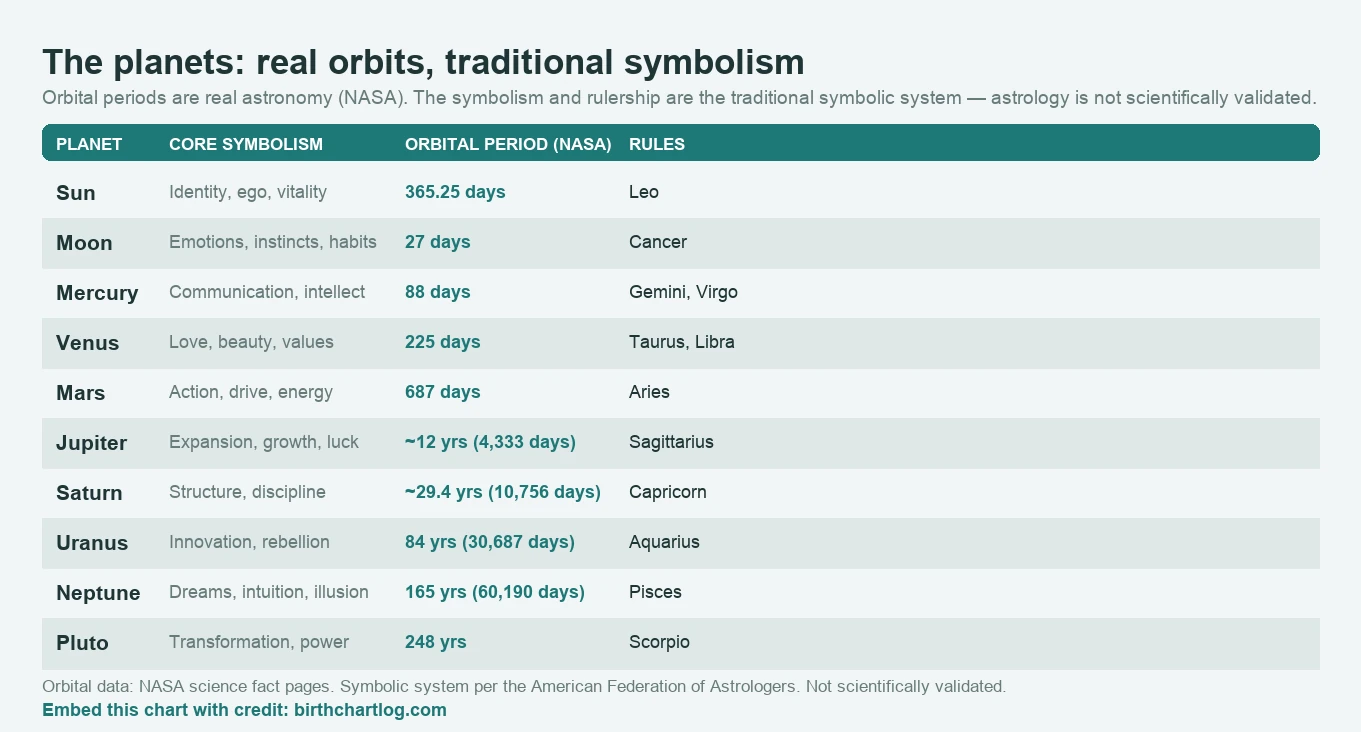
The honest split this page keeps on purpose: the orbital periods are real NASA astronomy — the Moon laps the zodiac in 27 days, Pluto takes 248 years — while the signs and houses are an old symbolic system, not something falsifiable. Britannica classifies astrology as a pseudoscience; treat the astronomy as fact and the symbolism as a hobby, not a forecast.
The Planets: Symbolism and Orbital Data
Quick vocabulary note before the table: astrologers count the Sun and Moon as "planets" too (they call them the Luminaries), which will never stop being a little funny to me given that NASA doesn't count either one, and Pluto got demoted from the club entirely. The planets don't care what category we file them under -- their orbits are the same regardless of which chart app you're using. The "Orbital Period" column is why some signs move fast (the Moon cycles through all twelve in under a month) and some barely move in your lifetime (Pluto takes the better part of two and a half centuries, so unless you're extremely well-preserved, it's parked in one sign your whole life). I pulled every number below straight from NASA's current fact pages for each body -- the old links here had rotted to a dead NASA archive path, so I re-sourced all ten.
| Planet | Core Symbolism | Orbital Period (Approx.) | Primary Rulership |
|---|---|---|---|
| Sun | Identity, ego, vitality, and the conscious self. | 1 year, 365.25 days (NASA) | Leo |
| Moon | Emotions, instincts, habits, and the subconscious. | 27 days (NASA) | Cancer |
| Mercury | Communication, intellect, logic, and reasoning. | 88 days (NASA) | Gemini, Virgo |
| Venus | Love, beauty, aesthetics, and personal values. | 225 days (NASA) | Taurus, Libra |
| Mars | Action, drive, aggression, and physical energy. | 687 days (NASA) | Aries |
| Jupiter | Expansion, growth, luck, and philosophy. | ~12 years, 4,333 days (NASA) | Sagittarius |
| Saturn | Structure, discipline, responsibility, and restriction. | ~29.4 years, 10,756 days (NASA) | Capricorn |
| Uranus | Innovation, rebellion, and sudden change. | 84 years, 30,687 days (NASA) | Aquarius |
| Neptune | Dreams, intuition, spirituality, and illusion. | 165 years, 60,190 days (NASA) | Pisces |
| Pluto | Transformation, power, rebirth, and the underworld. | 248 years (NASA) | Scorpio |
The Zodiac Signs: Elements and Modalities
For months I thought "modality" was one of those words astrology invents to sound more technical than it is. It isn't -- it's just shorthand for how a sign opens, sustains, or closes out a season. Cardinal signs kick a season off, fixed signs settle in and hold the line, mutable signs adapt and hand things to whatever's next. The four elements below go back to the same grouping the American Federation of Astrologers still teaches from its own history of the practice: fire, earth, air, and water. I didn't invent that grouping and neither did whatever app you're using -- it's just old.
| Sign | Element | Modality | Key Characteristics |
|---|---|---|---|
| Aries | Fire | Cardinal | Initiating, assertive, competitive. |
| Taurus | Earth | Fixed | Stable, sensual, persistent. |
| Gemini | Air | Mutable | Adaptable, curious, communicative. |
| Cancer | Water | Cardinal | Nurturing, protective, emotional. |
| Leo | Fire | Fixed | Expressive, creative, confident. |
| Virgo | Earth | Mutable | Analytical, practical, service-oriented. |
| Libra | Air | Cardinal | Diplomatic, harmonious, social. |
| Scorpio | Water | Fixed | Intense, investigative, transformative. |
| Sagittarius | Fire | Mutable | Adventurous, philosophical, optimistic. |
| Capricorn | Earth | Cardinal | Ambitious, disciplined, pragmatic. |
| Aquarius | Air | Fixed | Intellectual, humanitarian, original. |
| Pisces | Water | Mutable | Empathetic, artistic, spiritual. |
The Twelve Houses: Domains of Life
The house system is where I actually got tripped up switching apps last year -- same birth data, two different cusp lines, because the several house systems in common use slice up the wheel differently. It's a bit like two weather models pulling from the same satellite data and still disagreeing on tomorrow's forecast by a few degrees: the underlying sky is identical, the math carving it into twelve wedges isn't. What's not in dispute is the basic mechanism -- the American Federation of Astrologers notes that the division of the twelve houses is based on Earth's own daily rotation, not the zodiac's yearly one, which is why houses track things like your daily routine and relationships rather than personality traits.
- 1st House (Ascendant)
- Self-image, physical appearance, first impressions, and general outlook on life.
- 2nd House
- Personal finances, material possessions, self-worth, and values.
- 3rd House
- Communication, local environment, siblings, and early education.
- 4th House (Imum Coeli)
- Home, family, roots, ancestry, and the private self.
- 5th House
- Creativity, romance, pleasure, children, and self-expression.
- 6th House
- Health, daily routines, work environment, and acts of service.
- 7th House (Descendant)
- One-on-one partnerships, marriage, business contracts, and open enemies.
- 8th House
- Shared resources, intimacy, transformation, and psychological depth.
- 9th House
- Higher education, long-distance travel, philosophy, and belief systems.
- 10th House (Midheaven)
- Career, public reputation, social status, and long-term goals.
- 11th House
- Friendships, community, social groups, and future aspirations.
- 12th House
- The subconscious, isolation, spirituality, and hidden matters.
Last verified: 2026-07-11
Sources
- NASA Science: Mercury Facts
- NASA Science: Venus Facts
- NASA Science: Earth Facts
- NASA Science: Moon Facts
- NASA Science: Mars Facts
- NASA Science: Jupiter Facts
- NASA Science: Saturn Facts
- NASA Science: Uranus Facts
- NASA Science: Neptune Facts
- NASA Science: Pluto Facts
- American Federation of Astrologers: History of Astrology
- Encyclopedia Britannica: Astrology